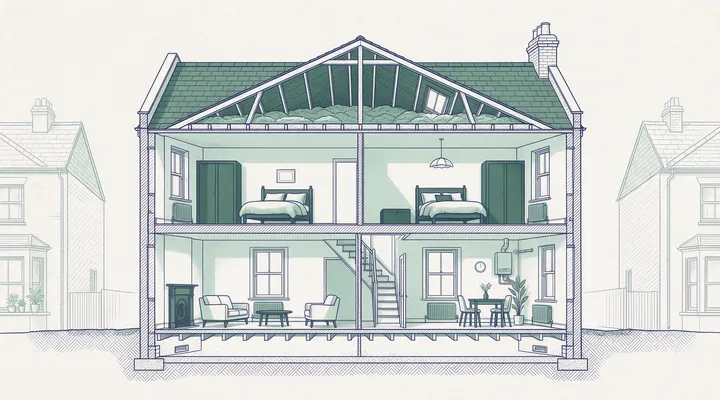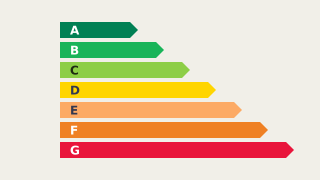

Solar panels can move an EPC rating by a whole band or more. This guide works out how many points they add using the published RdSAP 10 method, the calculation every assessor's software runs. It covers solar PV, the panels that make electricity. Solar water heating is recorded separately.
Why there is no fixed number of points
The EPC rating is a score for modelled running costs. The method adds up the cost of heating, hot water, lighting, pumps and fans, takes off the value of any electricity the home generates, and divides by the floor area plus 45. A score of 100 means zero net cost.
Two parts of that sum decide what solar is worth:
- Solar electricity is valued at 13.19p per kWh. In the RdSAP 10 rating that is the price of electricity bought on a standard tariff, and electricity sent to the grid from solar panels is priced the same. It makes no difference to the rating whether you use the electricity or export it.
- The saving is divided by floor area. The same panels save the same amount in the calculation, so they move a 50 m² flat further than a 120 m² house.
The method also uses UK average weather for the rating, so a home in London is not credited with more sun than one in Leeds.
How many points: worked examples
These figures come from working the published method through for panels facing south at a 30° pitch with little or no shading, on a home with a standard electricity meter. That gives about 860 kWh of electricity a year for every kWp (kilowatt peak) of panels. Points added, to the nearest whole point:
| Floor area | 2 kWp | 3 kWp | 4 kWp |
|---|---|---|---|
| 50 m² | 16 | 24 | 33 |
| 70 m² | 13 | 20 | 27 |
| 100 m² | 11 | 16 | 21 |
These are illustrations from the method, not a promise for your home. Homes rated F or G start on a different part of the scale, where the same saving moves the score a little less. The rest of the home doesn't change the solar gain itself, but it decides where you start and so which band you end up in.
For comparison, band D runs from 55 to 68 points. A home at the bottom of D needs 14 points to reach C at 69, which is why solar is often enough on its own.
What decides the gain
System size
Output rises in step with the peak power of the system, measured in kWp. Double the kWp and you roughly double the points. Your installer's paperwork states the kWp.
Direction and pitch
The assessor records the direction of each set of panels and a pitch of horizontal, 30°, 45°, 60° or vertical. Using the same 3 kWp system on a 100 m² home:
| Panels face | Points, about |
|---|---|
| South | 16 |
| South-east or south-west | 15 |
| East or west | 13 |
Pitches of 30° and 45° give almost the same result. Panels on different roof planes are entered as separate systems, up to three.
Shading
The assessor records shading as very little, modest, significant or heavy, judged by how much of the sky to the south is blocked. The method cuts the output to 80% for modest shading and to 50% for significant shading. On the same 3 kWp, south-facing, 100 m² example, modest shading brings the gain down to about 13 points and significant shading to about 8.
Floor area
The smaller the home, the bigger the effect of each kWp, as the table above shows. A flat with its own panels feeding its own supply gains more than a large house from the same system.
Batteries and diverters
A battery lets the home use more of its own solar electricity instead of sending it to the grid. On a standard electricity meter that makes little or no difference to the rating itself, because the method values used and exported solar electricity at the same 13.19p.
The running costs printed on the EPC use a different, current price list. From July 2026 that list prices standard-tariff electricity at 26.00p per kWh and electricity sold to the grid at 5.81p, so a battery can lower the costs shown on the certificate, and your real bills, without changing the rating much.
A PV diverter sends spare solar electricity to the immersion heater in a hot water cylinder. It is only counted where there is a cylinder, no battery and no solar water heating, and the assessor needs written evidence of its make and model. Because the method already values exported solar electricity at the full standard price, a diverter is mainly a way to cut bills, not to gain points.
Flats and shared roofs
Panels on the roof of a block count towards a flat's rating only when their output is connected to that flat's electricity supply.
- Panels wired to particular flats are credited to those flats.
- Panels wired directly to several flats are shared between them by floor area.
- Panels that supply the landlord's or communal supply give no credit towards the rating of any flat.
What the assessor needs to see
- The peak power (kWp), from the system specification, the wiring diagram near the meter or consumer unit, or the MCS certificate.
- A PV generation meter serving your home. The output only counts towards the assessment if there is one. If the assessor cannot confirm the panels feed a meter serving your home, they are recorded but not as connected.
- Battery details: the make, model and usable capacity. Without them, the default is 5 kWh per battery.
- Diverter details: written evidence of the make and model. Without it, the diverter cannot be entered.
If the kWp cannot be found at all, a single home's panels are estimated from the share of the roof they cover, at 0.12 kWp for each square metre of panel, facing south at 30° with modest shading unless recorded otherwise. The paperwork gives the real figure, so find it before the visit. Our preparation checklist lists the other documents worth having ready.
Solar in your EPC's suggested improvements
For a house or bungalow without a thatched roof, the EPC can suggest solar panels if the home has none. The suggestion is modelled as 2.5 kWp facing south at 30° with modest shading, and it only appears if it adds at least 1 point. Flats do not get this suggestion, even where solar could help.
Where panels are already fitted, the EPC can also suggest a battery or a diverter, under the same 1-point rule.
The indicative rating next to each suggestion is the figure worked out for your own home. For the other measures, and routes from D to C for common London homes, see how to improve your EPC rating. For what each band means, see EPC ratings explained.
If you have had solar fitted since your last EPC, a new assessment records it. To book, request your exact quote.
What it costs
An EPC is priced by the home’s internal floor area. Guide prices:
- Up to 40 m²Studios and compact flats£65
- 41–55 m²1-bedroom flats£75
- 56–75 m²2-bedroom flats and small homes£85
- 76–95 m²2–3-bedroom homes£95
- 96–115 m²3–4-bedroom houses£105
- 116 m² and overLarge homes, 4+ bedroomsfrom£120
A floor plan at the same visit saves up to £35. Same-day lodgement is £15 extra, and a next-day visit with the EPC lodged that day is £35 extra. Your exact price is confirmed before you book.
See every priceFrequently asked questions
How many EPC points do solar panels add?
It depends on the size of the system, the direction and pitch of the roof, shading and the floor area of the home. Worked through the RdSAP 10 method, 3 kWp of south-facing panels with little shading adds about 16 points to a 100 m² home, about 20 to a 70 m² home and about 24 to a 50 m² home. Your EPC's suggested improvements show the modelled figure for your own property.
Will solar panels take my home from D to C?
They can. Band D runs from 55 to 68, so a home at the bottom of D needs 14 points to reach C at 69. Worked through the method, 3 kWp of south-facing panels with little shading adds about 16 points to a 100 m² home and about 20 to a 70 m² one. Whether solar gets your home there depends on the system and the home, so check the indicative rating in the suggested improvements on your EPC.
Does a solar battery improve an EPC rating?
On a standard electricity meter, little or not at all. A battery lets the home use more of its own solar electricity, but the rating method values solar electricity at 13.19p per kWh whether it is used at home or sent to the grid. A battery can still lower your bills.
Do solar panels on the roof of a block of flats count towards my flat's EPC?
Only if their output is connected to your flat's electricity supply. Where the panels supply several flats, the output is shared between them by floor area. Where they supply only the landlord's or communal supply, they do not count towards your flat's rating.
What does the assessor need to see for solar panels?
The peak power (kWp) of the system, from the specification documents, the wiring diagram or the MCS certificate, and a PV generation meter serving the home. The assessor also records the direction, pitch and shading of each set of panels.
In your area
Ratings from EPCs lodged for existing homes, 01/01/2023 to 12/10/2026, from the GOV.UK register.
Sources
- SAP 10.2 specification (14 March 2025): section 13 and Appendices M1 and U3, BRE for DESNZ. Checked 30/10/2026.The rating equation ECF = deflator × total cost / (TFA + 45); solar output = 0.8 × kWp × annual solar radiation × overshading factor; the overshading factors in Table M1; the battery effect on the share used at home; the rules for panels serving several flats.
- RdSAP 10 specification (7 June 2026): sections 11.1, 11.2, 19.1, Table 32 and Table 33, BRE. Checked 30/10/2026.Ratings use UK average weather. Table 32 prices standard-tariff electricity and solar electricity sold to the grid both at 13.19p per kWh, with a deflator of 0.42. Unknown kWp is estimated as 0.12 × panel area. The solar recommendation is 2.5 kWp, facing south at 30° with modest shading, for houses and bungalows without a thatched roof, and a recommendation appears only if it adds at least 1 point.
- RdSAP 10 conventions v12.2: convention 9.05 Photovoltaics, BRE for MHCLG. Checked 30/10/2026.The kWp from system documents or the MCS certificate; a PV generation meter is required for the output to count; separate entries for panels on different roof planes; battery and diverter evidence.
- SAP 10 fuel prices for calculating fuel costs, from July 2026, BRE. Checked 30/10/2026.The separate price list for running costs: standard tariff 26.00p and electricity sold to the grid 5.81p per kWh.
Crown copyright material is used under the Open Government Licence v3.0.
Was this guide useful?