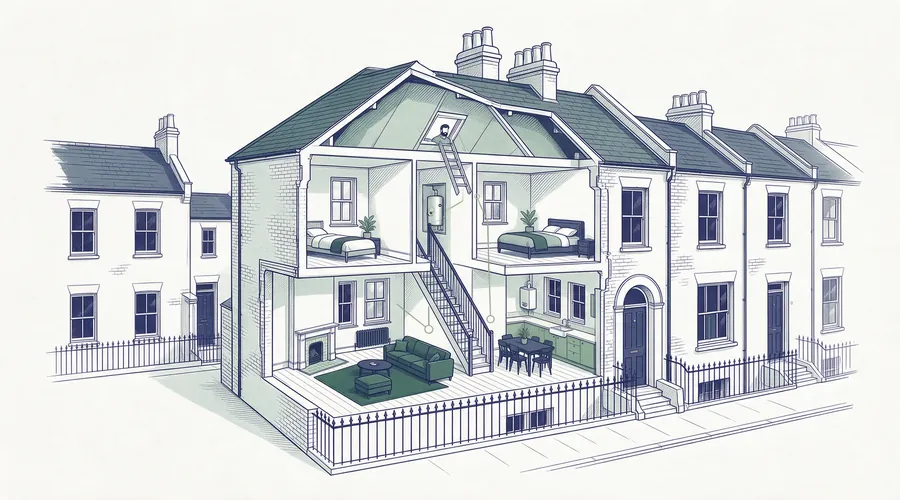

A maisonette is a home on two floors inside a bigger building, often above shops or in a block of flats with its own front door off a landing. For an EPC it is treated exactly like a flat. What makes the visit different is the second floor, the shared parts of the building around it, and sometimes a heating system you do not control.
Is a maisonette a flat or a house for an EPC?
A flat. The RdSAP 10 conventions say that a home which does not extend to every storey of its building is a flat or maisonette, and the calculation makes no distinction between the two. When you book, choosing Maisonette on the quote form tells your assessor to plan for two floors.
A maisonette needs its own EPC when it is a self-contained home that is being sold or let. Self-contained means it has its own fixed cooking and bathing facilities and its own entrance, from outside or from a shared corridor.
What the assessor records on each floor
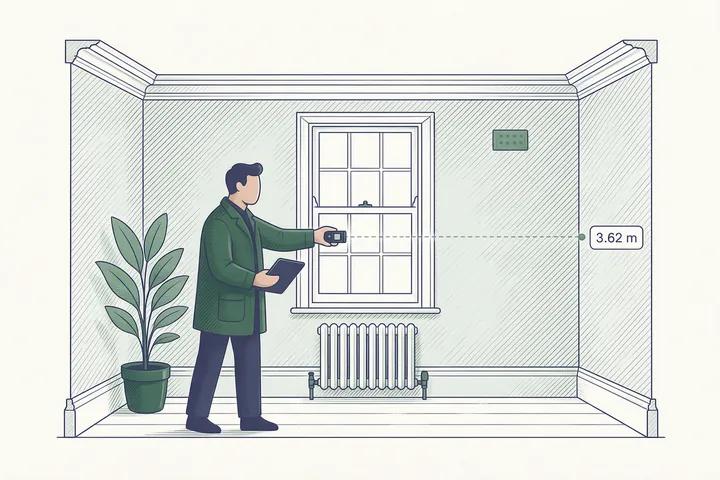
Both floors are measured, so the assessor needs to get into every room on each level. They record the floor area and room height of each storey, the windows on each floor, and how the walls of each part are built. If the upper floor was added later or built differently, it can be recorded as a separate part of the home with its own age and construction.
Your internal stairs are part of the home. The landing and stairs inside your front door are included in the floor area, though they are not counted as habitable rooms.
What is above and below you
This is the part people rarely think about, and it changes the result. The assessor records what each floor sits on and what the top floor sits under:
- Another home below or above: recorded as a floor or ceiling shared with a neighbour.
- A shop or other commercial space below: recorded as partially heated space below.
- A garage, bin store or unheated passage above or below: recorded as unheated space.
- A roof above: if you are on the top floor with a loft, the loft insulation is measured and photographed, so the assessor needs to reach the hatch.
If you know what is under your ground floor or over your top floor, tell your assessor. It saves guesswork when that space is not open to them.
The corridor or staircase to your front door
Most maisonettes are reached through a shared entrance, corridor or stairwell. How that space is recorded depends on whether it is heated, which means it has its own fixed heaters, not just warmth from pipes running through it:
- Heated corridor or stairwell: the wall between it and your home is treated like a wall shared with a neighbour.
- Unheated corridor or stairwell: that wall is recorded as a sheltered wall, which still loses heat to the colder space.
Assessors now photograph the corridor that leads to a flat or maisonette's entrance, so please make sure they can get into the shared areas.
A private staircase that leads only to your front door is different. If there is an external-quality door at the bottom, the staircase is treated as an unheated stairwell. If there is no such door, it is treated as part of your home.
Walls in a block of flats
Only the walls of your own home are recorded, not the construction of the whole building. If your maisonette has cavity walls and is on the third storey or above, the assessor records the cavity as hard to treat because of access, which affects how cavity wall insulation is recommended.
If the freeholder or the council has insulated the outside of the block, ask the building manager for the paperwork. Insulation that cannot be seen needs evidence before it can be recorded.
Heating: your own boiler or a shared system
A boiler inside your maisonette is your own heating system, even if the building has other homes on the same supply. Heat that comes from plant serving the wider building, such as a communal boiler room or a heat network, is recorded as community heating.
For community heating, the assessor looks for the scheme in the community heating database. A service charge statement or a letter from the heat supplier naming the scheme can help them find the right one.
What to have ready
- Access to every room on both floors, including any locked rooms.
- The loft hatch, if you are on the top floor.
- The boiler, hot water cylinder and heating controls, or the point where shared heating comes into your home.
- The gas and electricity meters. If they are in a shared cupboard, have the key ready.
- Access to the shared entrance and corridor or stairwell.
- Paperwork for anything that cannot be seen: insulation certificates, FENSA certificates for replacement windows, boiler installation records, and any letters about work done to the whole block.
The visit takes the same 45 to 90 minutes as other homes, depending on size. Our preparation checklist covers the rest of the day.
We cover all London boroughs, and appointment availability is confirmed before booking. See our pricing page for costs by floor area, or request your exact quote.
What it costs
An EPC is priced by the home’s internal floor area. Guide prices:
- Up to 40 m²Studios and compact flats£65
- 41–55 m²1-bedroom flats£75
- 56–75 m²2-bedroom flats and small homes£85
- 76–95 m²2–3-bedroom homes£95
- 96–115 m²3–4-bedroom houses£105
- 116 m² and overLarge homes, 4+ bedroomsfrom£120
A floor plan at the same visit saves up to £35. Same-day lodgement is £15 extra, and a next-day visit with the EPC lodged that day is £35 extra. Your exact price is confirmed before you book.
See every priceFrequently asked questions
Does a maisonette need its own EPC?
Yes, if it is a self-contained home that is being sold or let. A self-contained unit has its own fixed cooking and bathing facilities and its own entrance, either from outside or from a shared corridor. Any unit that is sold or let needs its own EPC.
Will a maisonette get a lower rating than a house?
The label itself does not change the rating. What changes it is what each wall, floor and roof sits next to: the outside, an unheated space, or another heated home. Two maisonettes in the same block can score differently for that reason alone.
Does the shared hallway or staircase count as part of my maisonette?
A communal corridor or stairwell is not part of your home. A private staircase that leads only to your front door counts as part of the home unless there is an external-quality door at the bottom of it, in which case it is treated as an unheated stairwell.
In your area
Ratings from EPCs lodged for existing homes, 01/01/2023 to 12/10/2026, from the GOV.UK register.
Sources
- RdSAP 10 conventions v12.2: conventions 1.02, 1.04, 2.03, 2.21, 2.24, 2.25, 3.14 and 4.05, BRE for MHCLG. Checked 22/10/2026.Flats and maisonettes treated alike; self-contained units; sheltered and party walls next to corridors; space above and below; private stairwells; walls in blocks of flats; community heating.
- RdSAP 10 specification (June 2026), BRE. Checked 22/10/2026.Party walls, sheltered walls and the heat loss perimeter.
- A guide to Energy Performance Certificates for the marketing, sale and let of dwellings, GOV.UK (DCLG). Checked 22/10/2026.Which units need their own EPC, and evidence for features that cannot be seen.
Crown copyright material is used under the Open Government Licence v3.0.
Was this guide useful?