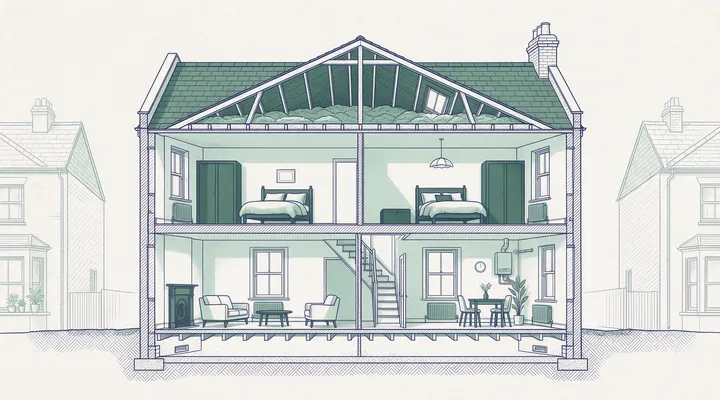

Many London flats, and some houses, are heated entirely by electricity: storage heaters, panel heaters, an electric boiler or a heat pump. Electric heating is one of the most common reasons a home gets a lower rating than its owner expects. This guide explains why, and what the assessor needs to record your system correctly.
Why electric heating often rates lower
The headline EPC rating is based on modelled running costs, not on how warm the home feels or how much carbon it emits. The method works those costs out using a fixed table of fuel prices in the RdSAP 10 specification:
| Fuel | Price per kWh in the method |
|---|---|
| Mains gas | 3.48p |
| Electricity, standard tariff | 13.19p |
| Electricity, 7-hour tariff, high rate | 15.29p |
| Electricity, 7-hour tariff, low rate | 5.50p |
These are fixed prices used for every EPC so that homes can be compared. They are not today's bills. They do explain the pattern: a unit of standard-rate electricity costs nearly four times as much as a unit of gas in the calculation, so the same home usually rates lower heated by direct electricity than by a gas boiler.
Your meter matters
Storage heaters charge overnight on cheaper off-peak electricity, so the method costs them mostly at the low rate. That only works if the home has a meter that records two rates.
- Storage heaters with a single-rate meter are recorded as panel heaters, costed at the standard rate.
- Two separate meters, one for on-peak and one for off-peak, are recorded as a dual-rate meter.
- A time-switch is treated as dual rate. A tele-switch is treated as single rate.
- A smart meter can be used as evidence if the unit or its display shows the readings. It does not need to be working at the visit.
The assessor may need to see a recent electricity bill to confirm your tariff. Have one ready, on paper or in your supplier's app.
How each electric system is recorded
Storage heaters
The assessor records the type: old large-volume, fan-assisted, integrated storage and direct-acting, or high heat retention. A high heat retention storage heater is only recorded as one if its brand and model are in the product database. If the assessor cannot find it there, it is recorded as a fan-assisted storage heater. The make and model are usually on a label on the side or underneath, or in the manual.
If you have more than one type of storage heater, they are treated as two main heating systems. A storage heater in a hallway or another room that is not a habitable room still counts as the main heating if it is the only heating in the home.
Panel heaters, electric radiators, underfloor mats and infra-red heaters
Direct electric heaters that heat straight from the mains are recorded as electric panel heaters. That includes electric underfloor heating mats and infra-red heaters.
Electric boilers
An electric combi boiler is recorded as a direct-acting electric boiler, with fuel type electricity.
Heat pumps
A heat pump is recorded from the product database by make and model. If it is not found there, a default efficiency is used. The system's design flow temperature is recorded as unknown unless documents show it was designed and commissioned as a low temperature system. Keep the installation and commissioning certificates, and show them to the assessor.
What to have ready
- A recent electricity bill showing your tariff.
- Access to the meter, or meters, and the consumer unit.
- The make and model of storage heaters or a heat pump, or their manuals.
- Installation and commissioning paperwork for a heat pump.
- Access to the hot water cylinder and immersion heater, if there is one.
Our preparation checklist covers the rest of the visit.
Improving the rating of an electrically heated home
The suggested improvements on your EPC show the measures modelled for your home. For electrically heated homes they often include heating controls, insulation and, where suitable, a change of heating system. What each one is worth depends on the whole home, so treat any figure as specific to that certificate.
If you are thinking of changing the heating, get advice from a suitably qualified installer first. Our guide on how to improve your EPC rating covers the other measures, and why two similar homes get different ratings explains how missing evidence can hold a rating down.
To book an assessment, request your exact quote.
What it costs
An EPC is priced by the home’s internal floor area. Guide prices:
- Up to 40 m²Studios and compact flats£65
- 41–55 m²1-bedroom flats£75
- 56–75 m²2-bedroom flats and small homes£85
- 76–95 m²2–3-bedroom homes£95
- 96–115 m²3–4-bedroom houses£105
- 116 m² and overLarge homes, 4+ bedroomsfrom£120
A floor plan at the same visit saves up to £35. Same-day lodgement is £15 extra, and a next-day visit with the EPC lodged that day is £35 extra. Your exact price is confirmed before you book.
See every priceFrequently asked questions
Do storage heaters affect the EPC rating?
Yes. How much depends on the type of storage heater and the meter. Storage heaters on a dual-rate meter are costed mostly at the off-peak price. With a single-rate meter they are recorded as panel heaters at the standard price, which usually gives a lower rating.
Do electric radiators improve an EPC rating?
Electric radiators that heat directly from the mains are recorded as electric panel heaters, whatever they are called when sold. They are costed at the standard electricity price, and every direct electric heater is recorded the same way, so changing from one kind to another does not change how the heating is recorded.
Does a heat pump improve an EPC rating?
It can, because a heat pump delivers more heat than the electricity it uses. How much it changes the rating depends on the home, the heat pump and the evidence. A heat pump not found in the product database is given a default efficiency, so keep the installation and commissioning paperwork.
What is the best electric heating for an EPC?
There is no single answer, because the result depends on the whole home. The suggested improvements on your EPC show the measures modelled for your property, and an installer can tell you what would suit it.
In your area
Ratings from EPCs lodged for existing homes, 01/01/2023 to 12/10/2026, from the GOV.UK register.
Sources
- RdSAP 10 specification (7 June 2026), section 19 and Table 32, BRE. Checked 29/10/2026.The SAP rating for RdSAP 10 uses the Table 32 fuel prices: mains gas 3.48p, standard electricity 13.19p, 7-hour tariff 15.29p high and 5.50p low, per kWh.
- RdSAP 10 conventions v12.2: conventions 4.01b, 4.02, 4.07, 4.14, 4.20, 4.22 and 9.13, BRE for MHCLG. Checked 29/10/2026.Storage heaters and meters; high heat retention heaters; panel heaters, underfloor mats and infra-red heaters; electric combi boilers; heat pumps not in the database; design flow temperature.
Crown copyright material is used under the Open Government Licence v3.0.
Was this guide useful?